IN HOME ASSISTANT
The ESP32 publishes the water temperatures, flow, compressor, estimated heat output and every compressor cycle: starts per hour, length of runs and stops. A card draws the refrigerant and water circuit with live values.
THE HEAT PUMP · ELECTRONICS · REVERSE ENGINEERING
My Hitachi heat pump knows everything about how it runs — water temperatures, flow, pressure, compressor — but only tells its display. The official gateway costs about €700 and is hard to find. So I listened to its wires.
THE NAME
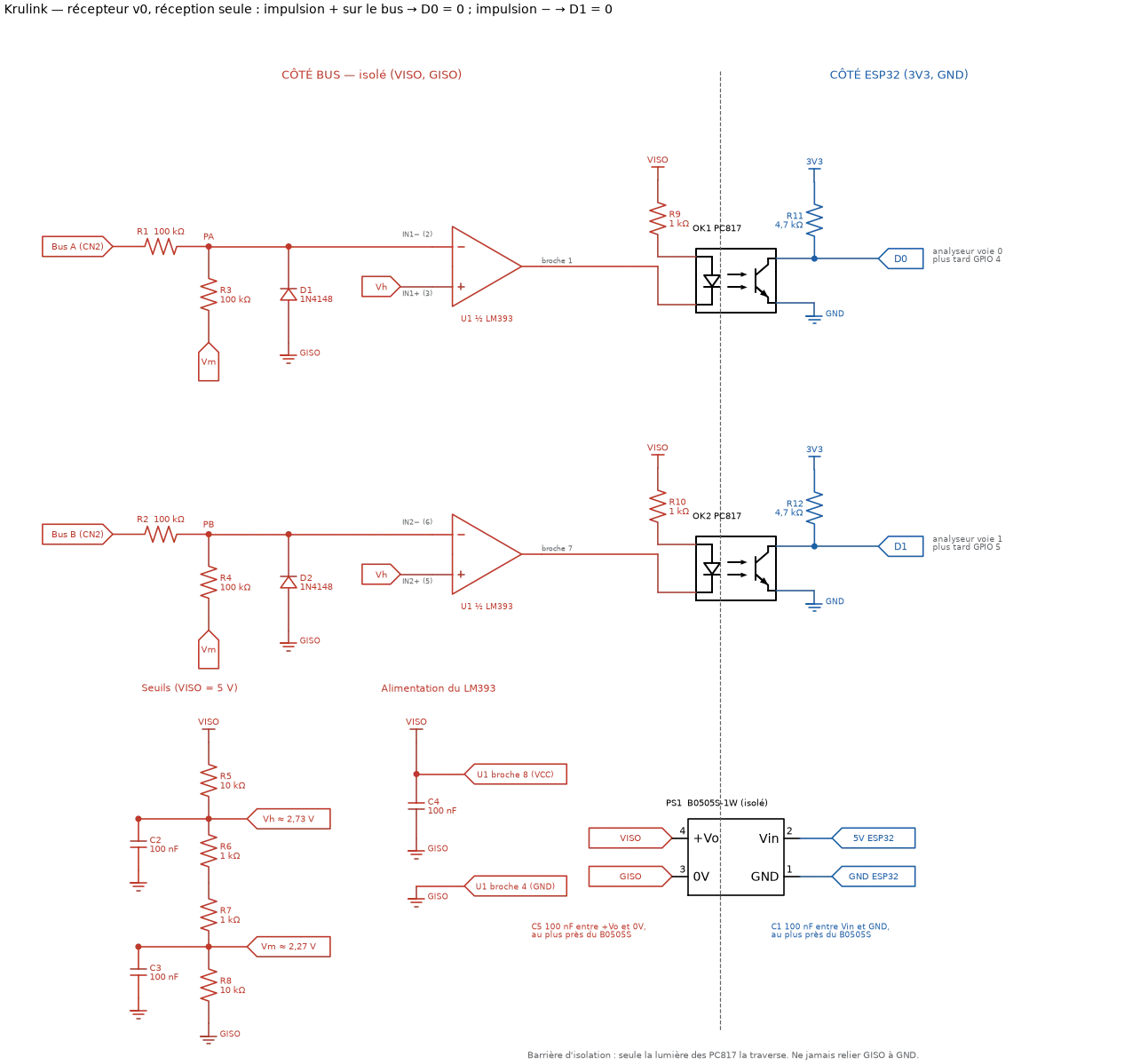
Kru(lab) + H-LINK, the name Hitachi gives to the two wires that connect its units. And one rule from day one: listen only. The circuit has no physical way to talk to the heat pump.
BEFORE THE FRAMES · FROM SIGNAL TO MESSAGE
1 · THE MULTIMETER
On the two wires, heat pump running: 0 V DC, a few tens of millivolts AC. So it is not a powered bus, and it is silent most of the time: the information travels in short bursts.
2 · THE OSCILLOSCOPE
On battery, to stay floating like the bus, triggered on the first pulse of a burst. On screen: +5 V and −5 V pulses about 50 µs long, alternating in sign, with a bit time of about 100 µs. That means 9,600 baud, and a precise encoding: one pulse for a 0, nothing for a 1.
3 · THE LOGIC ANALYSER
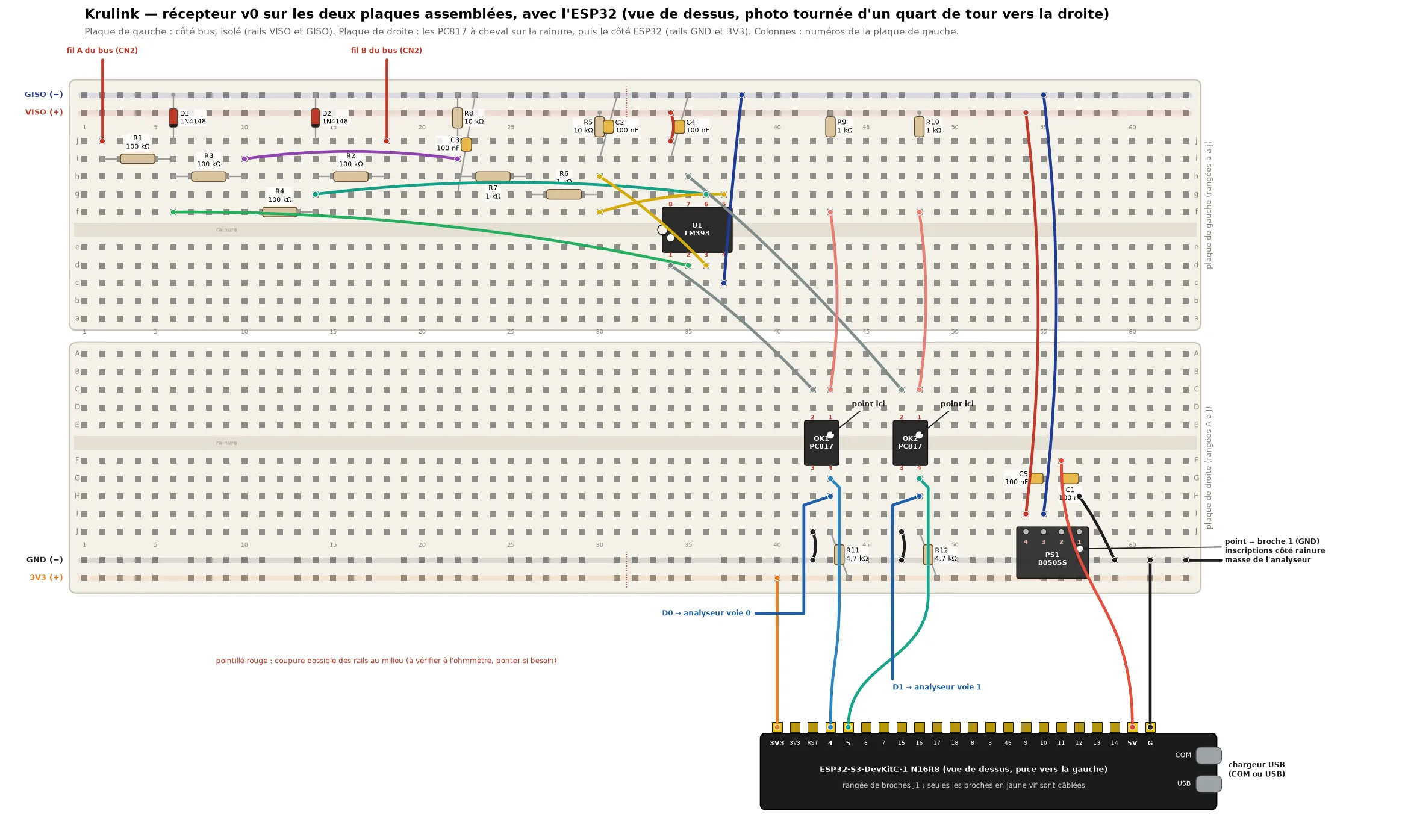
Never on the bus: behind the isolated receiver, which turns each positive and negative pulse into a clean edge on two channels. Recordings of 100 to 200 s at 1 MHz, and a decoder written for the job: bits, then bytes. Of the three possible parities, only one gives no error: 8E1.
4 · THE RIGHT MESSAGE
The bytes form frames: an address, a length, a check. To know which one carries what, each capture comes with photos of the display, and I trigger a change: I turn the thermostat's set point, the compressor starts, the water cools down. The frame that changes along with the screen is the right one.
REAL FRAMES · 24/11/2026
Three frames captured by the ESP32, with the compressor running. At the top, the pulses at the start of the frame: one pulse (alternately positive and negative) for each 0 bit, nothing for a 1 bit. Below, the bytes, and what I managed to read in them. Pick a frame, then a field:
radio thermostat receiver (9) → indoor unit (2), every 3 s
Click a coloured byte to see what it holds.
Status: “validated” = the value matched the display on at least three readings and moved with it during an experiment; “candidate” = matches, but not yet tested enough.
SINCE 24/11/2026
IN HOME ASSISTANT
The ESP32 publishes the water temperatures, flow, compressor, estimated heat output and every compressor cycle: starts per hour, length of runs and stops. A card draws the refrigerant and water circuit with live values.
A FIRST DIAGNOSIS
The data confirmed short cycles: runs of 4 to 6 minutes, more than three starts an hour in mild weather. Following the trail with the Hitachi manual, I found a badly set circulator, then the real bottleneck: a stretch of the radiator circuit that is too narrow and caps the flow. The work is planned.
THE ALARM, ON THE PHONE
Cleaning a filter made the water pressure drop: four “83” alarms in an hour. On the bus, one byte went from 0 to 83 each time, at the same minutes as the controller's history. The alarm code is validated, and Home Assistant now sends it to my phone, with its meaning.
TWO BUSES, NOT ONE
A setting changed on the controller never showed up in my captures. The installation manual and a test gave the answer: the heat pump has two H-LINK pairs. One links the outdoor unit and the radio thermostat, the one I listen to; the other links the controller. A second Krulink will listen to it.
01 · THE PROBLEM
Home Assistant only saw the heat pump's power consumption. Nothing about the water, the circulator or the compressor. Yet a first analysis had shown a circulator at 100% even when not heating (140 W standby) and compressor runs of 4 to 6 minutes. I had to see.
02 · WHAT I FOUND
A 9,600 baud, 8E1 bus, an address byte marked by odd parity, a length, an XOR check verified on thousands of frames, and three devices. Changing the set point on the radio thermostat showed who is who: the thermostat republishes its set point every 3 s — it is a state, not a command.
03 · THE METHOD
Captures paired with photos of the display, taken during the capture. A byte is only “validated” after three independent matches, and if it moves with the display during an experiment: changing the set point, letting the compressor start, letting the water cool down. A byte that always reads 100 proves nothing.
04 · TODAY
An ESP32 runs in the garage: it timestamps every edge to the microsecond, patches the micro-glitches the compressor injects, checks the checksum and parity, and sends every frame over Wi-Fi to my server. It updates over the air. Its decoder was checked byte for byte against the Python workbench's.
05 · THE SAFEGUARDS, AND WHAT'S NEXT
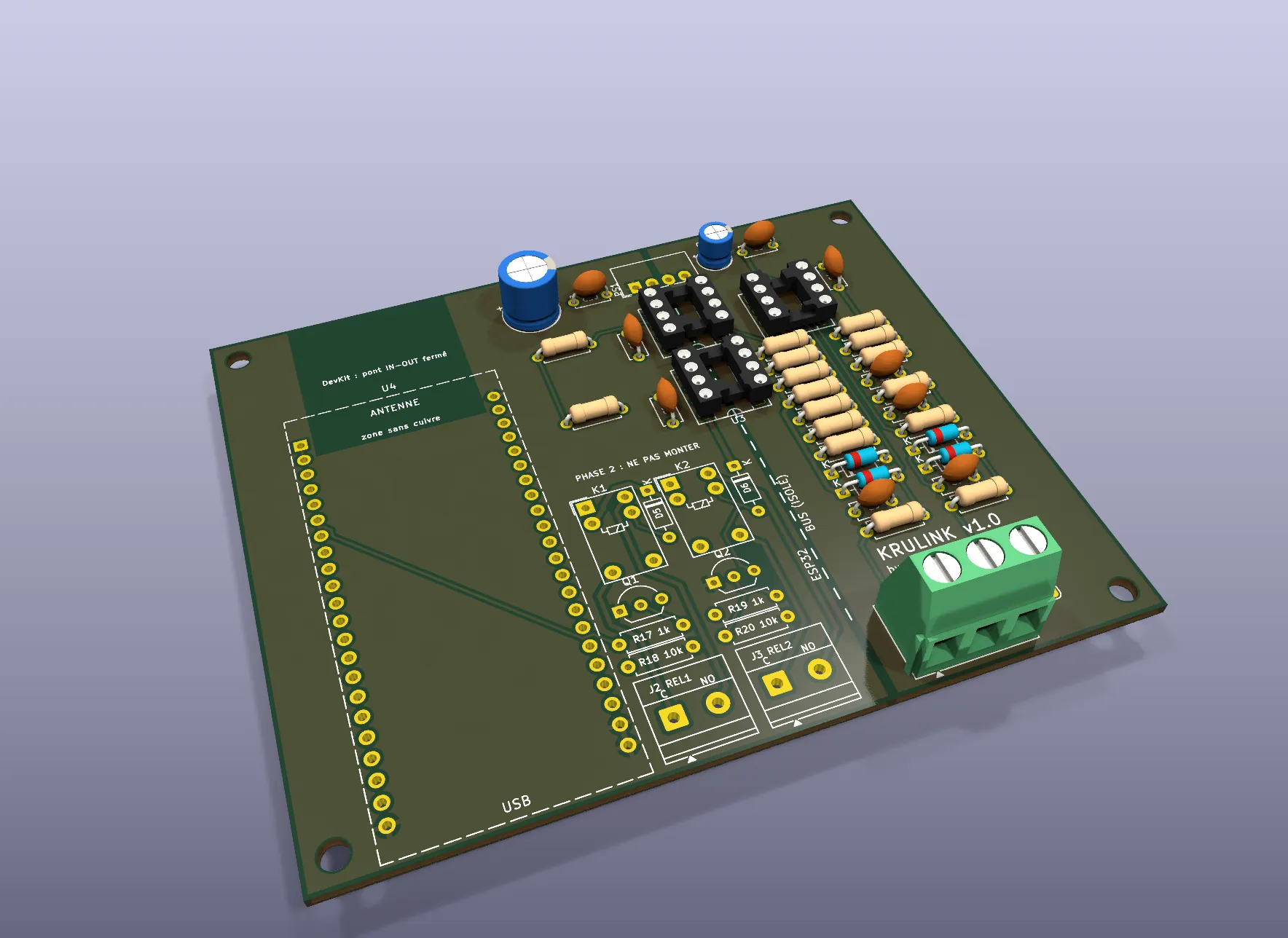
Listen only, high impedance, galvanic isolation: nothing can disturb the heat pump. Next steps: the v1 board in place of the breadboard, and a second Krulink on the controller's bus. Control will come later, first through the contacts Hitachi provides, and only with a physical switch that cuts transmission and a written rollback for every setting.